The Post-Pandemic Shift: Why Hybrid Marketing Teams Emerged
The rise of the hybrid marketing team has become unavoidable in today’s digital landscape. The pandemic didn’t create this shift—but it accelerated it dramatically. As consumer behavior changed overnight and digital adoption skyrocketed, brands could no longer operate with siloed creative and analytical teams. Marketers were suddenly required to respond with both speed and precision, blending creativity with data-driven decision-making.
- Enter the hybrid marketing team—a flexible, multidisciplinary unit designed to merge data intelligence with creative storytelling.
- This model reflects the reality of modern marketing:
- Campaigns now require real-time optimization.
- Personalization demands both human insight and machine intelligence.
- Creative ideas need performance validation.
- Data needs compelling narratives to drive emotional impact.
What Exactly Is a Hybrid Marketing Team?
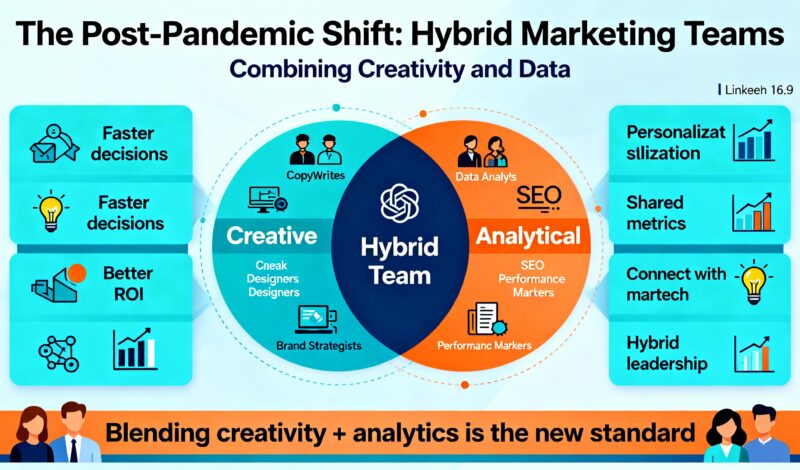
A hybrid marketing team integrates creative experts (writers, designers, strategists) with analytical talent (data scientists, performance marketers, automation specialists) in a single, collaborative structure.
This model eliminates the traditional friction between “right-brain” and “left-brain” roles.
Instead of passing briefs down a linear pipeline, hybrid teams work in loops:
Core Components of a Hybrid Marketing Team
- Creative Talent: Copywriters, art directors, brand strategists, video creators, social storytellers.
- Analytical Talent: Data analysts, SEO specialists, performance marketers, CRO experts, automation managers.
- Tech + Ops Layer: UX designers, martech managers, CRM specialists, AI/ML integrators.
- Leadership: A hybrid marketing leader capable of interpreting data and protecting creativity simultaneously.
By blending these diverse skill sets, organizations create a team that can generate bold ideas—and justify them with solid data.
The Benefits of Building a Hybrid Marketing Team
A hybrid marketing team creates a competitive advantage across nearly every marketing function. The impact is especially clear in a world where agility and precision matter more than ever.
-
Faster Decision-Making: With data and creative working side-by-side, feedback loops shrink. Teams can quickly test, learn, and iterate—without the delays caused by organizational silos.
-
More Personalized Customer Experiences: With analytical insights feeding into creative development, marketing becomes deeply tailored.
This delivers: - Higher engagement
- Improved conversion rates
- Stronger brand affinity
- Better ROI Through Continuous Optimization: Performance data influences campaign direction in real time.
Creative ideas evolve based on what works, not assumptions. -
Stronger Storytelling Backed by Evidence: The hybrid marketing team can validate what emotional triggers, visuals, and formats resonate—and amplify them across channels.
Essential Skills Required in a Hybrid Marketing Team
To thrive in a post-pandemic world, marketers need blended skill sets. No longer can a team rely on specialists who exist in isolation.
For Creative Talent
- Basic data literacy
- Understanding performance metrics
- Familiarity with content analytics tools
- Ability to interpret audience insights
For Analytical Talent
- Basic storytelling ability
- Comfort collaborating in creative sessions
- Understanding brand voice and visual identity
- Ability to translate data into creative opportunities
Cross-Functional Skill Sets
Some roles naturally blend these abilities:
- Growth marketers
- Creative strategists
- Social analysts
- Content performance managers
These roles become the backbone of the hybrid marketing team, bridging gaps and facilitating collaboration.
How to Build a Successful Hybrid Marketing Team
Implementing a hybrid structure requires intention, clarity, and investment in collaboration frameworks.
Step 1 — Break the Silo Mindset
The first step is cultural, not structural.
Leadership must encourage:
- shared KPIs
- co-owned outcomes
- cross-functional brainstorming
- constant communication
Step 2 — Create Shared Metrics Across Functions
Hybrid teams thrive when they pursue common success metrics such as:
- conversion lift
- engagement quality
- customer acquisition cost
- brand sentiment
Shared KPIs ensure that creative and analytical talent aren’t competing—they’re collaborating.
Step 3 — Invest in Technology That Connects Teams
Martech integration is essential to a hybrid marketing team.
Tools that matter include:
- collaborative dashboards
- AI content tools
- real-time analytics platforms
- automation systems
Technology ensures teams don’t just work together—they flow together.
Step 4 — Build a Hybrid Leadership Model
A hybrid team requires leaders who understand both creativity and analytics.
These leaders must:
- make data meaningful
- protect creative quality
- facilitate cross-functional synergy
- ensure decisions reflect both art and science
Challenges of the Hybrid Marketing Team Model
While powerful, this model comes with its complexities.
- Cultural Resistance: Creatives may resist data-driven constraints.
Analysts may reject subjective decision-making.Overcoming this requires transparency, training, and collaboration rituals. - Skill Gaps: Marketers must upskill to survive in hybrid environments.
Training becomes a long-term, ongoing need. - Technology Overload: Too many tools create chaos instead of cohesion.
Hybrid teams must streamline and consolidate platforms strategically.
The Future of Marketing Belongs to Hybrid Teams
The post-pandemic world demands marketers who can pivot fast, embrace complexity, and think holistically.
The brands winning today—and tomorrow—understand one truth:
Success comes from blending creativity with analytics, not choosing between them.
Hybrid teams aren’t just the future.
They are the new standard for marketing excellence.